Table ordering: mobile terminal, tablet, or fixed till?
Paper pad, fixed till at the counter, tablet, or pocket mobile terminal: table orders can be taken in several ways, and none of them is right everywhere. This guide compares these approaches and details what should actually guide the choice, from the layout of the dining room to the reliability of the network.
In this guide
Order taking is the moment when everything is decided in the dining room. This is where information enters the system: what the customer wants, how they want it, at which table, in what order. Everything that follows, in the kitchen as well as on the bill, depends on the quality of this entry.
Several ways of organising service coexist in French establishments. The paper pad, followed by entry at the counter. The fixed till, where the server comes back to register the order. The tablet, carried around the dining room. The rugged mobile terminal, which fits in an apron pocket. They do not always rule each other out, and the most recent is not automatically the most suitable.
This guide describes what each approach concretely involves, then the criteria that should weigh on your decision: the dining room, the distance, the type of service, the team and the network.
What's at stake at the moment of ordering
Behind the choice of a device, there are three organizational questions.
The first is the number of times the information is written downIf the server writes the order down on a pad and then re-enters it at the counter, the order is written twice. Each re-writing is an opportunity for error and a period during which the server is not on the floor.
The second is the moment when the kitchen receives the orderWith delayed entry, the kitchen finds out about the table when the server returns to the counter. With entry at the table, the order is sent straight from the dining room. It is not just a matter of speed: it changes the way orders are sequenced during a busy service.
The third is the relationship with the customerA server who enters the order at the table can confirm how a dish should be cooked, suggest a side, or check on an allergy right when the question comes up. Conversely, a poorly chosen device can create a visible barrier between the server and the table.
No technology settles these three questions for you. They are settled by observing your service as it actually unfolds.
The different ways of taking the order
The paper pad, then entry at the counter
Simple, silent, with no possibility of breaking down, understandable by any temporary staff member. The server writes it down, then enters the order into the till. The price to pay is double entry, the risk of misreading a handwritten note, and a kitchen informed only when the server returns.
The fixed till where the server comes back to enter
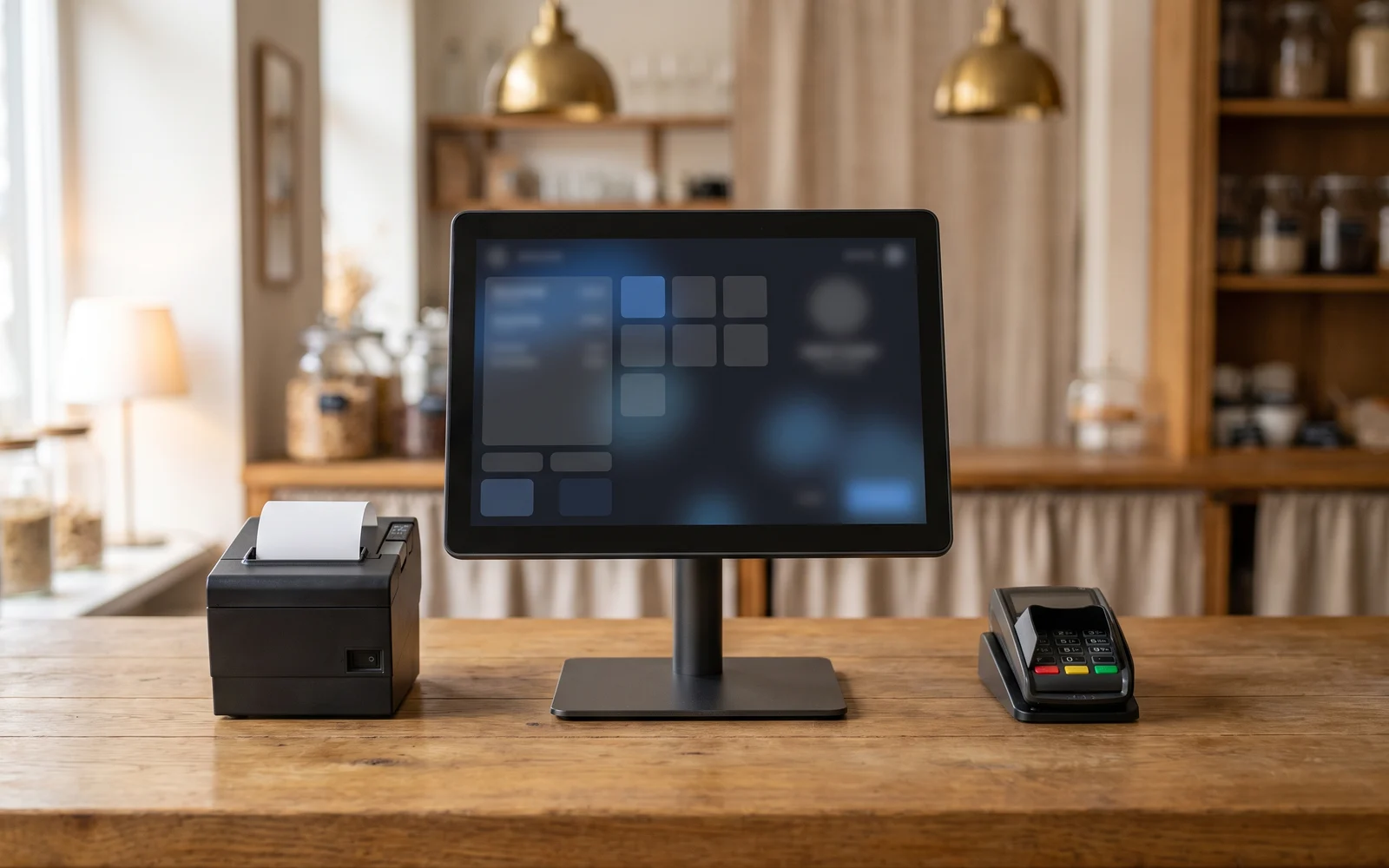
The order is entered directly into the software, with no intermediate paper, but from a fixed point. The server memorizes or jots it down, then enters it. This setup works well in a compact dining room, where the counter is within sight. It becomes tiresome as soon as the back-and-forth trips grow longer, and fixed stations create a queue between servers at the busiest times.
The tablet carried in the dining room
A large screen, comfortable reading of an extensive menu, easy entry of complex dishes and customizations. It suits services where the server takes the time to go into detail, and where numerous options are handled. In return, it occupies one hand, is hard to set down, and doesn't handle knocks or splashes well.
The pocket-sized rugged mobile terminal
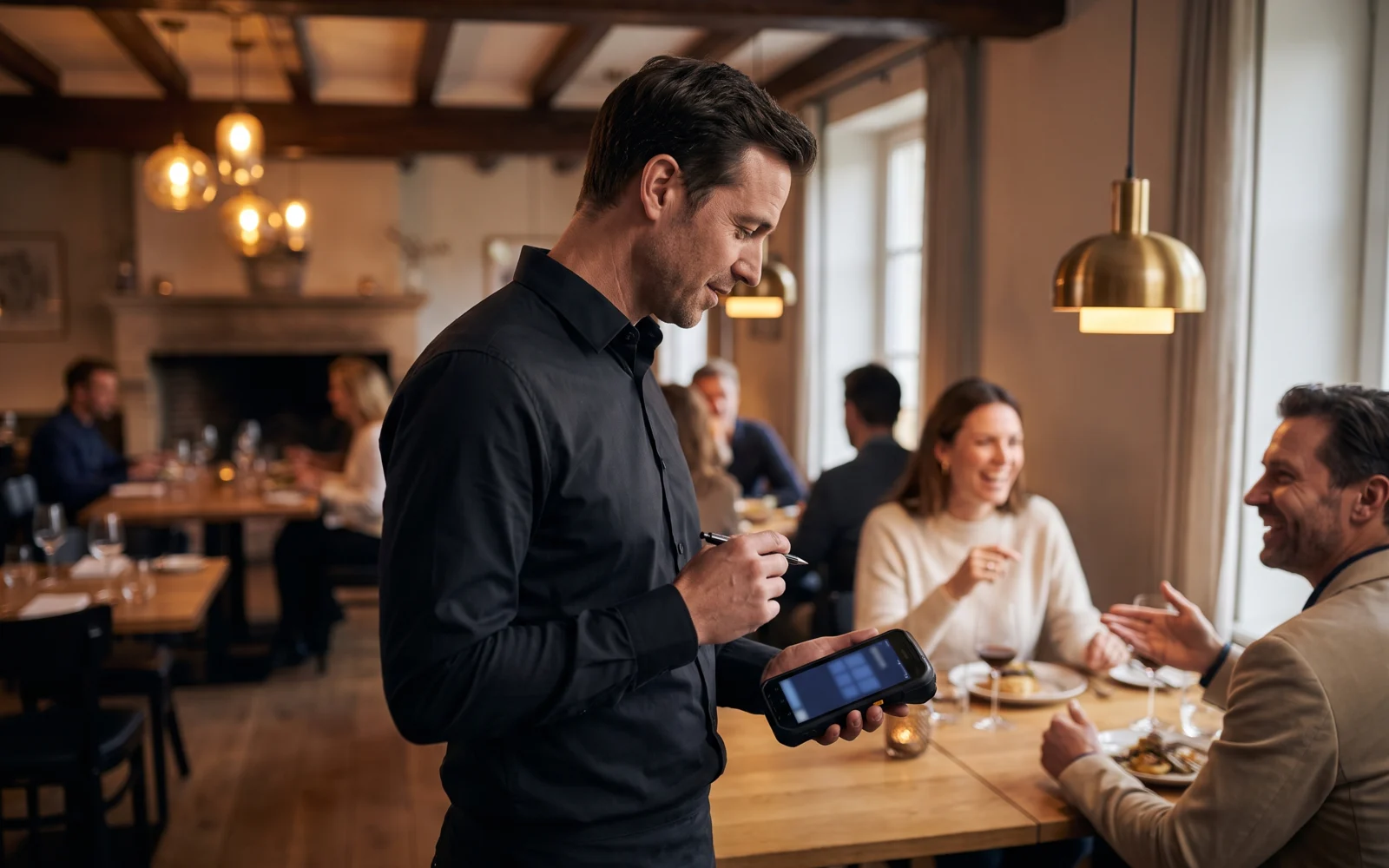
A compact device, designed to be held in one hand and tucked into an apron, built to withstand drops and cleaning. It suits quick service and large dining rooms, where the server moves around a lot. The smaller screen, however, requires a well-organised menu and careful setup to stay comfortable to use.
These approaches sometimes combine. An establishment can equip the terrace with mobile devices while keeping a fixed station for checkout, or reserve the tablet for the evening service.
Comparing on the right criteria
The table below compares the three most common setups. It does not name a winner: it shows where each one is comfortable.
| Criterion | Fixed till | Tablet | Mobile terminal |
|---|---|---|---|
| Entry | Deferred, at the counter | At the table | At the table |
| Reading comfort | Very good | Very good | Limited by screen size |
| Bulkiness for the server | None in the dining room | Occupies one hand | Fits in an apron |
| Extended dining room or terrace | Poorly suited | Suitable if distances remain reasonable | Suitable |
| Robustness in service | Protected terminal | Sensitive to impacts and liquids | Designed for intensive mobile use |
| Dependence on the network | Low | High | High |
What should guide your choice
The dining room and its layout
A small, single-room dining area, where the counter is visible from every table, does not necessarily justify mobile equipment. A series of connected rooms, a terrace separated by a street, an upper floor, or an inner courtyard completely change the reasoning: every order becomes a long trip, and it is that trip that mobility removes.
The number of servers and the flow of movement
The more servers there are, the more fixed terminals turn into a bottleneck during the rush. Observe who is waiting behind whom during your busiest service: this observation is often more revealing than any comparison of equipment.
The type of service
Quick service, with short baskets and a continuous flow, favours a pocket device that is taken out and put away without a second thought. Plated service, with dish-by-dish sends and customisations, benefits from a comfortable screen. Fine dining, where the exchange with the table is central, often calls for discretion: some establishments then prefer to keep the notepad and enter the order afterwards.
Input comfort and durability
A device is judged under real conditions: with one hand occupied, in dim lighting, with the full menu on screen. Also take into account daily cleaning, the drops that will happen, and how the device is put away between two tables.
Network coverage
This is the point that determines everything else. A mobile device is only as good as your establishment's wireless coverage. Terrace, cellar, upper floor, back room, thick walls: dead zones exist almost everywhere and can only be found by testing. A mobility project starts with a survey of the network, before any discussion of devices.
If wireless coverage is uncertain in part of your dining room, address this issue first. Mobile equipment installed on an unstable network causes lasting frustration, regardless of the quality of the hardware.
Mistakes to avoid
- Equipping the whole team without having tested it in real service, at the farthest tables and during the busiest hours.
- Neglecting menu configuration. On a mobile screen, a poorly organised menu makes order entry slower than a paper pad.
- Forgetting training. Moving to tableside order entry changes the flow of service, not just the server's tool.
- Not planning a backup solution in case a device breaks down or runs out of battery during a service.
- Choosing the device before having defined the organization. It is the organization of the table ordering that determines the equipment, never the other way around.
Preparing your decision
Three observations are often enough to decide: the actual distance between the farthest table and the counter, the number of servers present at the busiest time, and the state of wireless coverage in every area accessible to customers. Note these down before looking at any device at all.
The choice of terminal comes next, along with questions of format, robustness, and integration with the till software, which are checked case by case depending on the solution chosen.
OG Solutions analyses how the dining room operates and the constraints of the venue, then selects and configures the suitable solution from among the technologies it integrates. The restaurateur defines their organisation, the integrator chooses the technology that serves it.
Key takeaway
- Order taking determines the quality of everything that follows: what is entered incorrectly in the dining room arrives wrong in the kitchen and on the bill.
- The paper pad and the fixed till remain relevant in small, compact dining rooms, at the cost of double entry or back-and-forth trips.
- The tablet offers reading comfort useful for detailed menus, while the rugged mobile terminal suits large dining rooms and fast-paced service.
- The layout of the dining room, the distance to the counter, the number of servers and the type of service matter more than the equipment's specifications.
- The reliability of wireless coverage determines the success of any mobility project and must be checked area by area before choosing a device.