Automatic coin dispenser: which businesses really benefit from it?
The automatic coin dispenser handles cash on the retailer's behalf: the customer inserts their coins and notes, the machine checks them and gives change. Useful in some businesses, superfluous in others. This guide helps you position your own business before considering this equipment.
In this guide
Many retailers have seen an automatic coin dispenser in a bakery or a canteen and asked themselves the same question: would this make sense for my business? The answer is not the same for a tobacconist-newsagent, a plated-service restaurant, or a clothing store. It depends less on the size of the business than on the actual share cash takes up in your takings and the pace of your counter.
The coin dispenser is a significant commitment. It takes up space, changes the sales motion, and requires a minimum of daily organization. Choosing it without having clarified the need often leads to an underused machine, sitting next to a cash drawer that people keep opening out of habit.
The aim of this guide is simple: to understand what a coin dispenser really does, identify the situations where it adds value, recognize those where it adds nothing, and know the concrete constraints before deciding.
What an automatic coin dispenser actually does
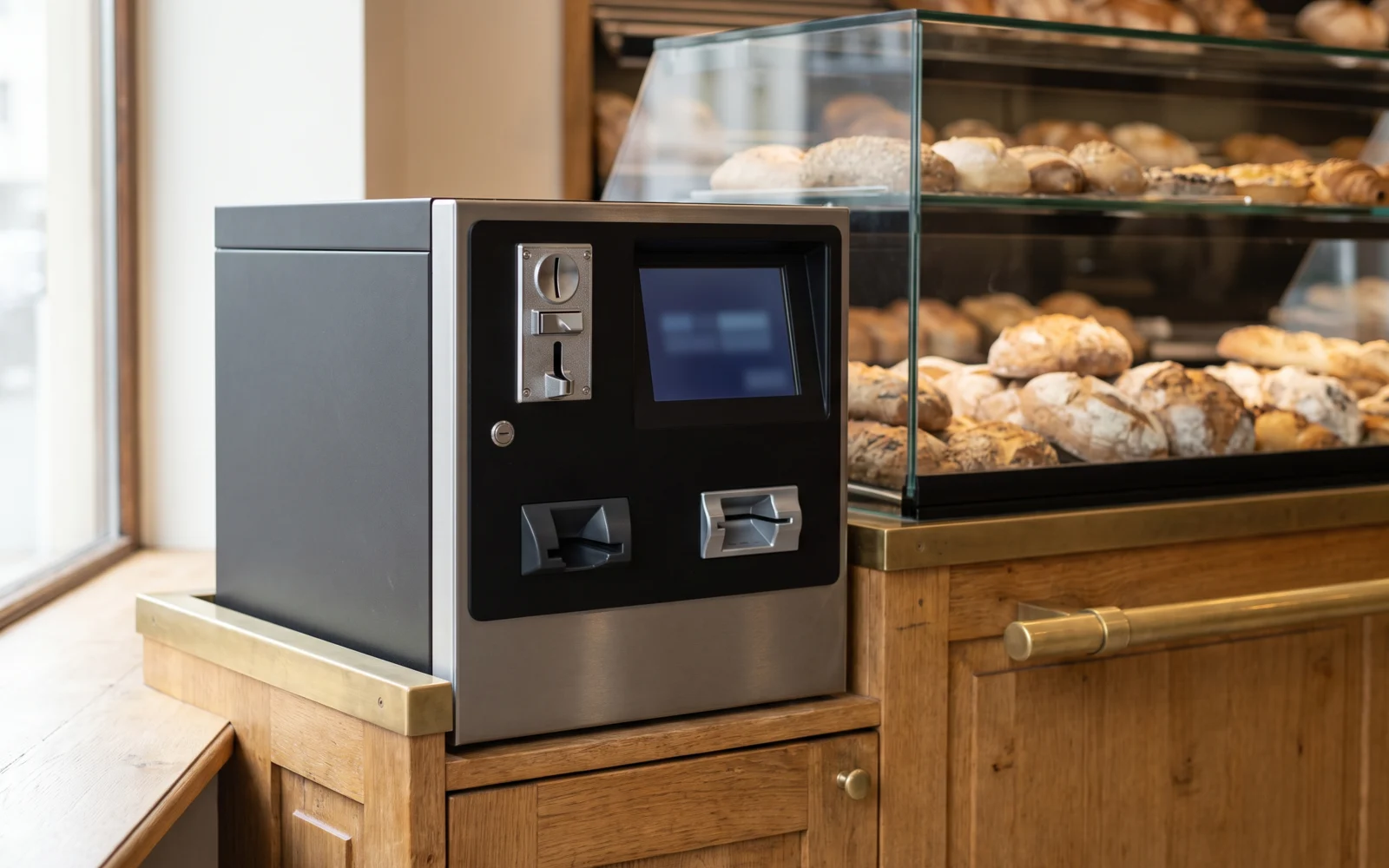
An automatic coin dispenser is a cash-handling machine connected to the till. Once the sale is recorded, the amount to be paid is sent to it. The customer inserts their own coins and notes into the designated slots. The machine identifies them, checks them, stores them in internal cassettes, and then gives change automatically.
The main change can be summed up in one sentence: cash no longer passes through the hands of the person handling checkoutThe salesperson no longer counts cash, gives change, or opens the drawer. They assist the customer, check that the payment went through, and move on to the next one.
Three consequences follow. First, the cash float lives inside the machine, rather than in an accessible drawer. Second, counting becomes a matter of reading what the machine has recorded, rather than a manual end-of-day exercise. Finally, the distinction between the person who sells and the person who handles the money disappears, since no one handles money at the point of sale anymore.
One point deserves to be stated clearly: a coin dispenser only handles cash. Card payments still go through a payment terminal, and other payment methods keep their usual path. A coin dispenser is therefore not a replacement for the till, but a peripheral added to acheckout already thought out.
What's at stake behind the question
When a shopkeeper takes an interest in a coin dispenser, it's almost never for the machine itself. It's for a problem they deal with every day and struggle to put into words.
The first is the pace. Giving change interrupts the sale. At a quiet counter, this goes unnoticed. At a busy counter, each interruption adds to the last and turns into a line visible from the street.
The second is the cash discrepancy. A change-giving error isn't detected at the time. It shows up in the evening, as a difference that no one can explain, especially when several people have handled checkout during the day.
The third is hygiene of movement, particularly in food businesses, where the same person handles both products and cash. Separating the two actions is a long-standing concern in food trades.
The fourth is peace of mind: a cash float stored in a machine does not have the same status as a drawer opened in front of everyone. If your motivation doesn't fit into any of these four categories, the equipment risks meeting no real need.
Situations where a coin dispenser makes sense
Some contexts combine several of the favorable conditions. These are the ones to look at first.
A cash share that remains significant
This is the entry condition. If most of your payments already go through card, the coin dispenser will handle only a minority of transactions and its value becomes questionable. Look at your actual payments over a representative period, not your impression of them.
A fast-paced counter with small basket sizes
Many quick sales, paid in coins, with pronounced peaks during the day. A bakery at rush hours, a neighborhood grocery store in the evening, a fast-food outlet at lunch service.
A food business
When the same person serves the product and takes payment, separating cash handling from the act of serving is a motivation in itself, regardless of any time saved.
Several people on the same cash float
Shifts that rotate, extra staff, seasonal work. When several hands share the same drawer, no one is responsible for a discrepancy anymore. The coin dispenser removes this ambiguity.
A need to make closing more reliable
If the end of the day regularly ends with a long count or unexplained discrepancies, the automated system turns this manual step into simply reading a recorded state.
When it isn't justified
An honest guide must also say in which cases this equipment does not bring much.
- When cash has become marginal in your business. The need then concerns card payment, not the automation of change.
- When the average basket is high and the number of transactions low. A long, advised sale is not hurt by an occasional change-giving delay.
- When checkout does not take place at a fixed point: table service paid for in the dining room, mobile selling, market stalls. A coin dispenser requires a stable position.
- When the counter is already saturated and no space can be freed up without harming the relationship with the customer.
- When the real issue lies elsewhere: poorly configured software, badly organised items, untrained staff. An automated device does not fix a shaky checkout setup.
The concrete constraints to anticipate
The coin dispenser is a mechanical machine installed in a high-traffic spot. It needs to be planned for as such, not just as a line item in a till project.
Space and placement
This is the most underestimated constraint. The machine takes up space at the counter, it must be accessible to the customer, at a comfortable height, without forcing the salesperson to turn around or break eye contact. The layout should be planned on paper, with the existing furniture, before any decision is made.
Restocking
A machine that gives change must have change available. You therefore need to organise the supply of coins and notes, decide who is responsible, when, and how to handle a shortage of small denominations on a very busy day.
Maintenance
Coins and notes get dirty. An automatic coin dispenser requires regular cleaning of the transport paths and attention to damaged or rejected notes. This maintenance is part of the routine, not the unexpected.
Training and the message to the customer
The team must know what to do when the machine rejects a bill, when a customer hesitates, or when an incident blocks a transaction. Some customers, particularly older ones, need guidance the first few times. Allowing for this settling-in period avoids concluding too quickly that the equipment isn't suitable. Guidance at theinstallation and training is prepared beforehand.
A coin dispenser does not eliminate incidents: it changes their nature. You are no longer looking for a change-giving error, you are dealing with a jam or a rejected note. What matters is knowing who on the team knows how to respond.
Preparing your decision
Before comparing machines, clarify three things. The actual share of cash in your takings. The number of people taking payment from the same till float. The space actually available at the counter. These three answers are usually enough to know whether the topic is worth pursuing further.
Only then come the equipment questions: format, capacity, how it connects with the till software and with the payment terminal. These points must be checked case by case, depending on the solution chosen, not in general terms.
OG Solutions analyses the business's checkout needs, then selects and configures the suitable solution from among the technologies it integrates. The approach stays the same: the retailer understands their need, the integrator chooses the technology that meets it.
Key takeaway
- The automatic coin dispenser has cash collected by a machine: the customer inserts it, the machine checks it and gives change, and staff no longer handle the money.
- It makes sense when cash remains significant, when the counter is busy, or when several people take payments from the same till float.
- It is not justified if payments are mostly made by card, if transactions are few, or if checkout has no fixed point.
- Counter space, cash replenishment, and maintenance are daily constraints to anticipate right from the assessment stage.
- Equipment doesn't fix a poorly organized checkout process: the configuration and training must be addressed first.