One till station or several: how to size your installation?
Should you have a single till or several? The answer doesn't depend on the total number of customers in a day, but on how footfall is concentrated, the length of a checkout in your business, and the number of people checking out at the same time. This guide offers a simple observation method, concrete situations, and the alternatives to consider before adding a second fixed till.
In this guide
When preparing a till installation, one question almost always comes up: is a single checkout terminal needed, or several? It seems simple. It rarely is, because it depends less on the size of the business than on how customers arrive and how they are served.
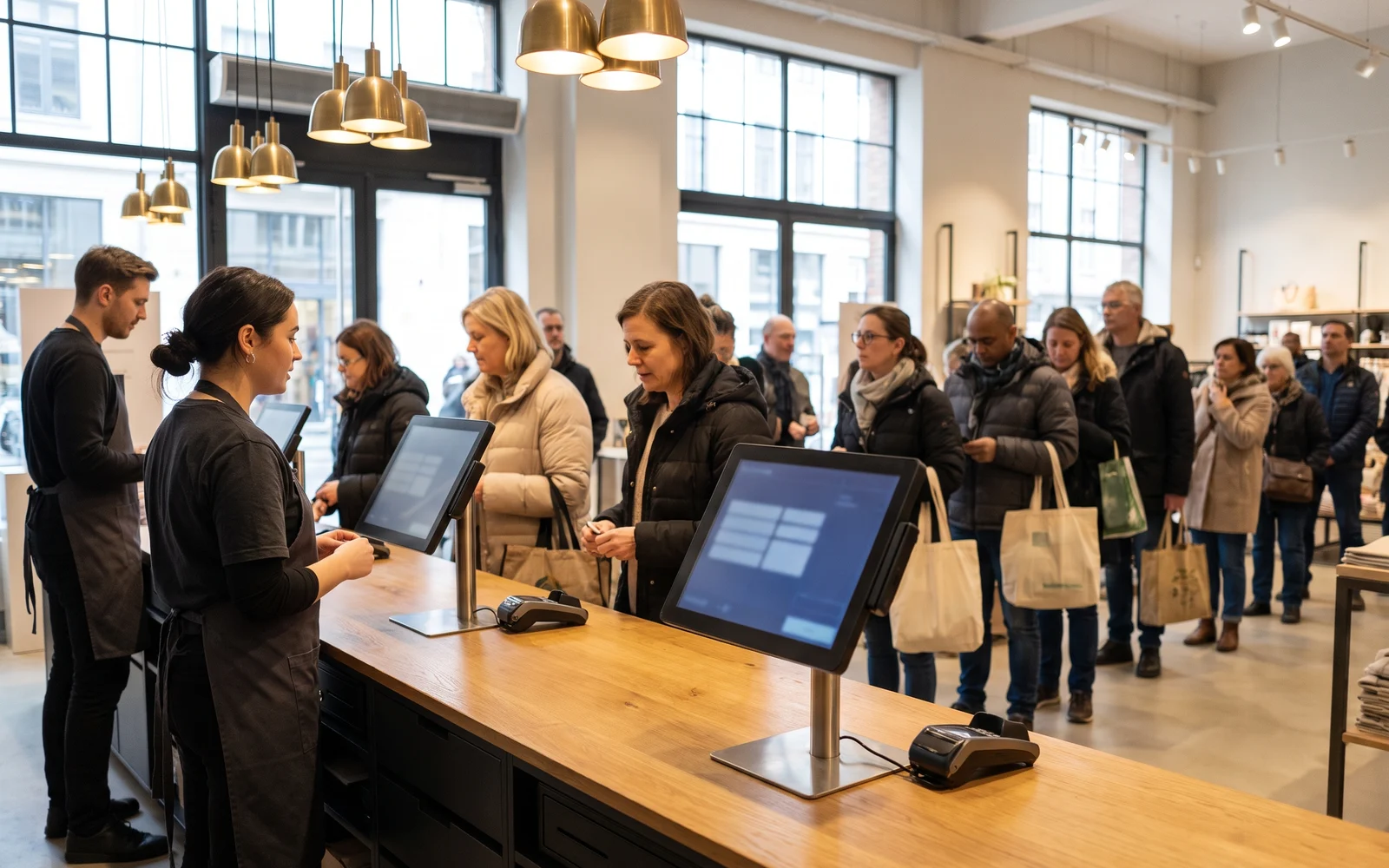
A point of sale that is quiet most of the time may need a second till if it experiences sudden peaks. Conversely, a very busy business can function with a single till if footfall is spread out and each checkout remains brief. The day's total footfall is therefore not enough to decide.
This guide offers a way of thinking: what to observe in your activity, and what solutions exist besides adding a fixed station. The aim is to help you formulate your need precisely before discussing it with an integrator.
What's at stake behind the number of stations
Sizing your installation is not just about avoiding a queue. Several issues overlap.
The first is the customer comfortA wait perceived as long at the moment of payment leaves a lasting impression, even if the rest of the experience went well. The second is the staff comfort when only one person is handling checkout during a peak, they end up combining order-taking, preparation, checkout, and customer questions. Service quality declines even before the line gets longer.
The third topic is the continuityWith a single terminal, a technical fault, a jammed printer or a simple mishap brings checkout to a halt. A second terminal, even a modest one, provides a fallback solution.
The fourth isorganization of the spaceAn additional terminal takes up counter space and requires power, a connection, and room to move around. In a counter that is already crowded, it can create a bottleneck instead of solving one.
Look at the concentration of footfall, not the total
This is the point most often overlooked. Two businesses that serve the same number of customers in a day have completely different needs if one receives them steadily from morning to evening and the other over two short windows.
The useful question is therefore not “how many customers per day,” but “at what moment does everyone arrive at the same time.” An office closing time, a lunch service, the end of a market, the end of a cinema screening, Saturday afternoon: these are the time slots that determine sizing, not the average.
Observe a typical week
Note, over several representative days, the moments when a queue actually forms and those when the counter is free. Direct observation is worth more than an estimate from memory.
Identifying the length of peak periods
A very short peak is not handled the same way as a peak that spreads over an entire service. In the first case, a one-off reinforcement is often enough; in the second, the setup must sustain the load continuously.
Counting the people who check out customers
An extra till station is only worthwhile if there is someone to staff it. If your peak-time headcount does not allow you to staff two stations, the problem lies elsewhere.
Adding equipment does not create staff: a second terminal that stays empty during the peak does not reduce waiting time.
The length of a checkout varies according to the business
A checkout does not involve the same content everywhere. In some businesses, it comes down to a few gestures; in others, it strings together many operations. Without getting into precise timings, it is useful to list what lengthens a transaction in your business.
- The number of lines per receipt a single item is not entered the same way as a full basket.
- The nature of the entry scanning a barcode, selecting on a touchscreen, weighing, manually entering a product that has no code.
- The ancillary operations packaging, cutting, preparing a drink, bagging, age verification, gift wrapping.
- The payment method payment split between several people, payment using multiple methods, special vouchers, giving change.
- The additional actions looking up a loyalty account, issuing an invoice, a question about a product asked during checkout.
The more steps a transaction involves, the more a single terminal becomes a bottleneck, even with moderate footfall. Conversely, a business where the transaction is quick can absorb high footfall on a single terminal.
Concrete situations
A few configurations come up often. They clearly illustrate that the need depends on the organization, not just the volume.
A counter and a terrace
Customers seated outside don't follow the same path as those who order at the counter. Checking everyone out in the same place forces staff to make trips back and forth and interrupt the line.
A separate section
A deli counter, a wine cellar, a fresh produce section, or an advice area where the customer is served individually creates a second point of contact. The question then becomes: should this section handle its own checkout, or send the customer to the main till?
Order pickup
When part of the sales are prepared in advance, pickup is quick but slots into the regular line. A separate pickup point prevents two very different flows from getting in each other's way.
Exceptional periods
Year-end holidays, tourist season, a weekly market, a local event: some businesses see peaks that bear no relation to the rest of the year. Sizing the entire setup around these periods can be disproportionate.
In this last case, it is less about adding a permanent station than about planning temporary capacity for these periods.
Alternatives to a second fixed station
Before doubling up the counter, several approaches deserve to be examined. They are not all equal and do not address the same situations.
| Clue | What it brings | Its limitations |
|---|---|---|
| Second fixed station | Lasting capacity, a full station, and a fallback in case of an incident on the first one. | Takes up space, requires available staff and a reorganisation of the counter. |
| Mobile terminal | Allows checkout to happen wherever the customer is, in the dining room, on the terrace or in the aisle. | Requires a suitable organization and reliable network coverage throughout the space. |
| Remote checkout | Separates order-taking from checkout, or shifts payment to another point. | Changes the team's habits and requires clear cues for the customer. |
| Counter reorganization | Streamlines the existing setup by reviewing the layout, the flow of movement, and the preparation. | Does not create additional capacity when demand truly peaks. |
Reorganization is often the first thing to try. A poorly placed station, where the operator keeps turning around or the customer hesitates about where to stand, loses smoothness regardless of the equipment. Moving an element, rethinking the direction of the queue, or moving a preparation step earlier sometimes changes more than adding a station.
The possible configurations depend on the solution chosen and the equipment selected: the feasibility of each option needs to be checked on a case-by-case basis. If you are preparing this topic, the page need: checkout describes the points to clarify beforehand, and the mobile equipment gives an overview of the existing formats.
Common mistakes and next step
Three mistakes come up regularly.
The first is to size for the busiest day of the yearThe setup becomes oversized the rest of the time, cumbersome and harder to manage day to day. It is better to size it for a typical peak and plan reinforcement for the exceptional case.
The second is toadding a station without revisiting the organisationTwo terminals side by side that share the same preparation area and the same customer flow can get in each other's way.
The third is toforgetting future growthAn expansion, extended hours, or a new takeaway sales activity change the need. It is better to know from the outset under what conditions the setup can be expanded.
Before making any decision, list in writing your peak periods, the number of people taking payment at that time, and the distinct sales areas of your point of sale. These three elements are enough to frame the discussion.
Next step
Once these observations have been gathered, the decision becomes much more concrete. OG Solutions analyses the checkout needs of a point of sale, then selects and configures the appropriate solution from among the technologies it integrates, taking into account the available space and the team's organisation.
Key takeaway
- The number of stations is decided based on the concentration of foot traffic during peak hours, not the total number of customers in a day.
- The length of a checkout depends on the business: the number of lines per receipt, side operations, and payment methods matter as much as footfall.
- An extra till station is only useful if someone can actually staff it during peak time.
- Separate sales areas, such as a terrace or a pickup point, often create the real need for a second checkout point.
- Mobile terminal, remote checkout, or simply reorganizing the counter should be examined before adding a fixed station.